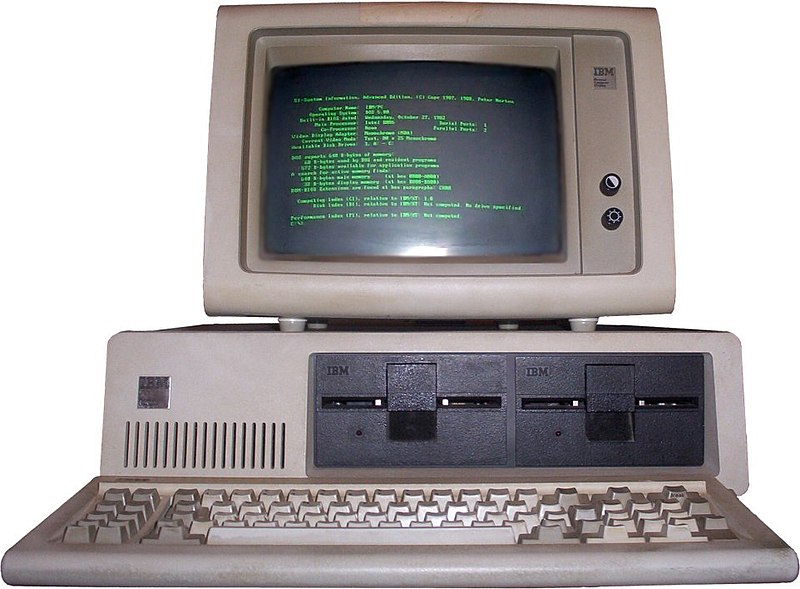

The capabilities of the PC have changed greatly since the introduction of electronic computers. By the early 1970s, people in academic or research institutions had the opportunity for single-person use of a computer system in interactive mode for extended durations, although these systems would still have been too expensive to be owned by a single person. The introduction of the microprocessor, a single chip with all the circuitry that formerly occupied large cabinets, led to the proliferation of personal computers after about 1975. Early personal computers - generally called microcomputers - were sold often in Electronic kit form and in limited volumes, and were of interest mostly to hobbyists and technicians. Minimal programming was done by toggle switches, and output was provided by front panel indicators. Practical use required peripherals such as keyboards, computer terminals, disk drives, and printers. Unlike other hobbyist computers of its day, which were sold as kits; in 1976 Steve Jobs and Steve Wozniak sold the Apple I was a fully assembled circuit board containing about 30 chips. Such that by 1977 Apple Computers introduced the Apple II, as the world’s first personal computer. By 1977, mass-market pre-assembled computers allowed a wider range of people to use computers, focusing more on software applications and less on development of the processor hardware.
Throughout the late 1970s and into the 1980s, computers were developed for household use, offering personal productivity, programming and games. Somewhat larger and more expensive systems (although still low-cost compared with minicomputers and mainframes) were aimed for office and small business use. Workstations are characterized by high-performance processors and graphics displays, with large local disk storage, networking capability, and running under a multitasking operating system. Workstations are still used for tasks such as computer-aided design, drafting and modelling, computation-intensive scientific and engineering calculations, image processing, architectural modelling, and computer graphics for animation and motion picture visual effects.[1]
Eventually the market segments lost any technical distinction; business computers acquired color graphics capability and sound, and home computers and game systems users used the same processors and operating systems as office workers. Mass-market computers had graphics capabilities and memory comparable to dedicated workstations of a few years before. Even local area networking, originally a way to allow business computers to share expensive mass storage and peripherals, became a standard feature of the personal computers used at home.
[edit]Market and sales
Personal computers worldwide in million distinguished by developed and developing world
In 2001 125 million personal computers were shipped in comparison to 48 thousand in 1977. More than 500 million PCs were in use in 2002 and one billion personal computers had been sold worldwide since mid-1970s until this time. Of the latter figure, 75 percent were professional or work related, while the rest sold for personal or home use. About 81.5 percent of PCs shipped had been desktop computers, 16.4 percent laptops and 2.1 percent servers. United States had received 38.8 percent (394 million) of the computers shipped, Europe 25 percent and 11.7 percent had gone to Asia-Pacific region, the fastest-growing market as of 2002. The second billion was expected to be sold by 2008.[2] Almost half of all the households in Western Europe had a personal computer and a computer could be found in 40 percent of homes in United Kingdom, compared with only 13 percent in 1985.[3]
The global PC shipments was 264 million units in year 2007, according to iSuppli[4], up 11.2 percent from 239 million in 2006.[5]. In year 2004, the global shipments was 183 million units, 11.6 percent increase over 2003.[6] In 2003, 152.6 million PCs were shipped, at an estimated value of $175 billion.[7] In 2002, 136.7 million PCs were shipped, at an estimated value of $175 billion.[7] In 2000, 140.2 million PCs were shipped, at an estimated value of $226 billion.[7] Worldwide shipments of PCs surpassed the 100-million mark in 1999, growing to 113.5 million units from 93.3 million units in 1998.[8]. In 1999, Asia had 14.1 million units shipped.[9]
As of June 2008, the number of personal computers in use worldwide hit one billion, while another billion is expected to be reached by 2014. Mature markets like the United States, Western Europe and Japan accounted for 58 percent of the worldwide installed PCs. The emerging markets were expected to double their installed PCs by 2013 and to take 70 percent of the second billion PCs. About 180 million PCs (16 percent of the existing installed base) were expected to be replaced and 35 million to be dumped into landfill in 2008. The whole installed base grew 12 percent annually.[10][11]
In the developed world, there has been a vendor tradition to keep adding functions to maintain high prices of personal computers. However, since the introduction of One Laptop per Child foudation and its low-cost XO-1 laptop, the computing industry started to pursue the price too. Although introduced only one year earlier, there were 14 million netbooks sold in 2008.[12] Besides the regular computer manufacturers, companies making especially rugged versions of computers have sprung up, offering alternatives for people operating their machines in extreme weather or environments.[13]
[edit]Average selling price
For Microsoft Windows systems, the average selling price (ASP) showed a decline in 2008/2009, possibly due to low-cost netbooks, drawing $569 for desktop computers and $689 for laptops at U.S. retail in August 2008. In 2009, ASP had further fallen to $533 for desktops and to $602 for notebooks by January and to $540 and $560 in February.[14]
[edit]Netbooks and nettops
The emergence of new market segment of small, energy-efficient and low-cost devices designed for access to the Internet (netbooks and nettops) could threaten established companies like Microsoft, Intel, HP or Dell, analysts said in July 2008. A market research firm International Data Corporation predicted that the category could grow from fewer than 500,000 in 2007 to 9 million in 2012 as the market for low cost and secondhand computers expands in developed economies. [15] Also, after Microsoft ceased selling consumer versions of Windows XP, it made an exception and continued to offer the operating system for netbook and nettop makers.[16]


No comments:
Post a Comment